Pet turf installation Arizona homeowners search for regularly, and yet most of what comes up online is either too vague to be useful or written by someone who has clearly never installed a yard in this state.
Arizona is not like most of the country when it comes to artificial turf. The soil conditions are different, the heat is more extreme, the drainage requirements are more demanding, and the consequences of a poor install show up faster than they would in a cooler climate. A yard installed incorrectly in Phoenix or Chandler will have odor problems by June and drainage problems by monsoon season. A yard installed correctly will look and perform well for 15 years with minimal effort.
At Pet Turf Haven, we have installed pet turf across Chandler, Tempe, Scottsdale, Queen Creek, Phoenix, and the wider East Valley for over a decade. This guide covers the full installation process, what each step involves, what it costs, and what questions to ask before you hire anyone. For anyone starting to research pet turf installation Arizona options, the most important thing to understand upfront is that not every installer has experience with Arizona-specific soil and climate conditions, and that difference shows up in the results.
Why Arizona Installations Are Different From the Rest of the Country
Before getting into the process, it helps to understand why Arizona-specific experience matters when choosing an installer.
Three things make Arizona installations uniquely demanding:
Caliche soil is found throughout the Phoenix metro area and across the East Valley. This hard, calcium-rich layer sits beneath the surface and blocks natural drainage entirely. Any installer who does not specifically address caliche during base preparation is creating a system that will trap urine and rainwater underneath the turf. The result is odor that cannot be fixed without pulling the entire installation up and starting over.
Extreme UV exposure degrades lower-quality turf products faster in Arizona than in most states. Turf that carries a 15-year warranty in a northern climate may perform significantly worse here without UV-stabilized fibers. Product selection matters more in Arizona than almost anywhere else.
Monsoon drainage is a factor unique to this region. Short, intense rainfall events in July and August can dump significant water into a yard very quickly. A base system that handles gradual rain will fail under monsoon conditions if it is not properly graded and compacted.
These are not selling points, they are practical realities. Any installer who does not address all three upfront is worth questioning.
Pet Turf Installation Arizona – Step-by-Step Process Explained
Here is exactly what a proper installation involves, from the first site visit to the final walkthrough.
Step 1 – Free on-site estimate and site assessment
Every installation starts with a site visit. This is not just a measurement exercise. A good installer is assessing soil conditions, existing drainage direction, sun exposure, fence line and edge constraints, and HOA requirements if applicable. The quote you receive should reflect the specific conditions of your yard, not a generic per-square-foot number applied to every job.
Step 2 – Existing surface removal
Natural grass, weeds, existing gravel, and the top layer of soil are removed. The depth of removal depends on the base depth required for your drainage system, typically 3 to 4 inches. This step also includes initial caliche identification, if a hard layer is present it needs to be broken up before any base material goes in.
Step 3 – Caliche break-up and grading
This is the step that separates professional Arizona installs from budget ones. Any caliche present is broken up and removed or incorporated into the subgrade. The surface is then graded to direct drainage away from the structure and toward a permeable area or drain point. Getting the grade right is what prevents standing water during monsoon season.
Step 4 – Weed barrier installation
A commercial-grade weed barrier goes down across the entire area before any base material is added. This prevents weed growth from coming up through the turf over time, which is a genuine problem in Arizona’s soil conditions.
Step 5 – Crushed granite base
A 3 to 4 inch layer of compacted crushed granite is laid and graded across the entire area. This is the drainage layer that makes everything else work. Crushed granite allows liquid to pass through quickly while remaining stable under foot traffic and extreme heat. The compaction level matters, too loose and it shifts over time, too compact and drainage slows.
Step 6 – Turf installation
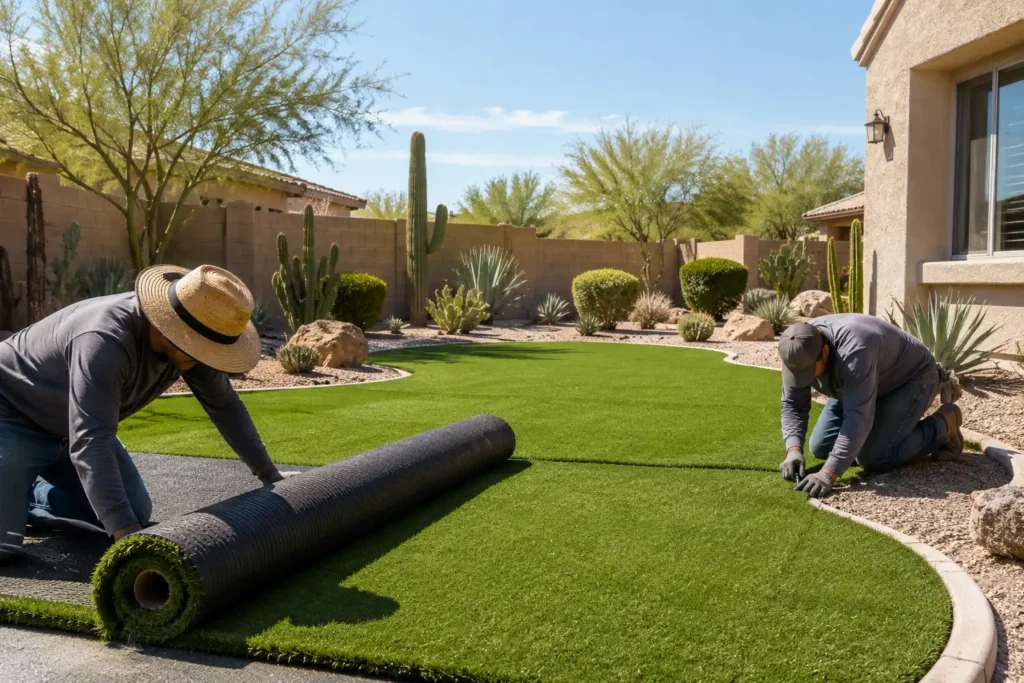
The pet-safe turf is rolled out, cut to fit the yard precisely, and secured along all perimeters. Seams, where two pieces of turf meet, require careful alignment and proper joining technique to be invisible after installation. This is a skill that separates experienced installers from those who are new to the trade.
Step 7 – Antimicrobial infill application
Infill is distributed evenly across the turf surface and power-brushed into the blades. For pet installations in Arizona, antimicrobial infill like Envirofill is strongly recommended over standard sand or crumb rubber. The difference in odor control through a Chandler or Phoenix summer is significant, and the cost difference on a standard backyard is relatively minor.
Step 8 – Final walkthrough and inspection
Before we leave, every install gets a full walkthrough with the homeowner. Edge finishing, seam visibility, drainage slope, infill distribution, and surface appearance are all checked. Anything that is not right gets fixed before the job is considered complete.
How Long Does Pet Turf Installation Take in Arizona?
Most pet turf installation Arizona residential projects are completed in one to two days. Here is a realistic breakdown by project size:
| Project Size | Typical Timeline |
|---|---|
| Small dog run or side yard (under 200 sq ft) | Half day to 1 day |
| Standard backyard (300 to 600 sq ft) | 1 full day |
| Large backyard (700 to 1,200 sq ft) | 1 to 2 days |
| Very large or complex yards (1,200+ sq ft) | 2 to 3 days |
Yards that require significant caliche removal, complex grading, or HOA documentation preparation may add time. We give homeowners a realistic timeline before work begins, not an optimistic estimate that changes once the crew is on site.
2026 Pet Turf Installation Costs in Arizona
Here is what Arizona homeowners are realistically paying for pet turf installation Arizona projects in 2026:
| Project Size | Estimated Cost |
|---|---|
| Small dog run (100 to 200 sq ft) | $1,200 – $2,800 |
| Medium backyard (400 to 600 sq ft) | $4,500 – $8,000 |
| Large backyard (800 to 1,200 sq ft) | $9,000 – $16,000+ |
These figures include full base preparation, antimicrobial infill, and perimeter finishing. Quotes that come in significantly below these ranges in Arizona are almost always cutting corners on the base system or using standard infill, which will cost more in the long run.
The Arizona Department of Water Resources administers conservation programs that may include rebates for removing natural grass and replacing it with artificial turf. Verify current eligibility and rebate amounts directly at the Arizona Department of Water Resources before signing any installation contract, as program terms change regularly.
For a detailed breakdown of what installation costs across specific East Valley cities, our pet turf cost guide for Chandler covers local pricing in more detail.
What to Look For When Choosing a Pet Turf Installation Arizona Company
Arizona has no shortage of pet turf installation Arizona companies. Here is how to separate the ones worth hiring from the ones worth avoiding.
Ask specifically about caliche handling
If an installer cannot explain how they handle caliche on your property, that is a serious red flag. Ask directly: do you break up caliche if present, and how do you verify the base grade before laying turf? A confident, specific answer tells you they have done this before in Arizona conditions.
Request a written product specification
Ask for the turf product name, pile height, blade weight, infill type, and base depth in writing before signing anything. Vague quotes without specifications give you no way to compare bids or hold the installer accountable after the job is done.
Check what the warranty actually covers
A 15-year material warranty sounds strong, but read what it excludes. Many warranties do not cover odor issues, drainage failures, or pet damage, which are the most likely problems in a pet turf installation. Our installations come with a 15-year material warranty and a separate labor warranty covering the installation itself.
Verify they have done HOA work in your area
If your neighborhood is HOA-managed, ask whether the installer has experience getting turf approved in your specific community. Scottsdale, Chandler, and parts of Queen Creek have strict HOA standards around turf appearance, color, and edge finishing.
For more on what the installation process looks like specifically for pet-safe systems, visit our pet-safe installation service page where we cover product standards and what each install includes.
After Installation – What Comes Next
A properly completed pet turf installation Arizona system requires minimal ongoing effort, but a few habits make a real difference in Arizona’s climate.
During the first two weeks after installation:
- Avoid heavy use for the first 24 to 48 hours while infill settles
- Do an initial hose rinse after the first day to help infill distribute evenly
- Check drainage after the first rain or irrigation cycle to confirm water is moving as expected
Ongoing maintenance for pet turf in Arizona:
- Hose rinse once or twice per week during summer months
- Remove solid waste promptly, especially in the heat
- Apply an enzyme-based cleaner monthly for homes with multiple dogs
- Professional deep clean once or twice per year depending on pet activity level
For a complete guide to keeping your turf clean and odor-free through Arizona summers, our artificial turf cleaning guide for Chandler covers the full maintenance routine in detail.
Ready to Get Started?
If you are planning a pet turf installation Arizona project anywhere in the Phoenix metro area or East Valley, we are happy to visit your yard, assess the site conditions, and give you a clear, written quote with no pressure.
Call us at (928) 427-2477 to book your free on-site estimate.
You can also visit our areas we serve page to confirm we cover your neighborhood across Chandler, Tempe, Scottsdale, Queen Creek, Phoenix, and the wider East Valley.
Leave a Reply