Dog turf deodorizer Arizona homeowners search for every summer, and most end up trying three or four products before figuring out what actually works in this climate.
The problem is not that deodorizers do not work. The problem is that most people are using the wrong type of product for the wrong kind of odor, and Arizona’s heat makes a mediocre solution fail faster than it would anywhere else in the country.
If your artificial turf smells like dog urine despite regular rinsing, the answer is not more water. It is the right deodorizer applied the right way at the right frequency. At Pet Turf Haven, we install and maintain pet turf across Chandler, Tempe, Phoenix, and the East Valley. Dog turf deodorizer Arizona questions come up constantly in our work, and this guide covers everything you need to know to actually solve the problem.
Why Arizona Makes Turf Odor Worse Than Anywhere Else
Before getting into solutions, it helps to understand why Arizona-specific conditions make turf odor harder to manage than in cooler states.
Three things work against you here:
Heat activates bacteria faster. Dog urine contains uric acid, which bacteria break down into the ammonia-like compounds that create the smell. In a state where surface temperatures regularly exceed 140°F in summer, that bacterial activity happens significantly faster than in a 70°F climate. A yard that might stay fresh for two weeks in Oregon needs attention every four to five days in Chandler or Phoenix.
Standard infill holds moisture. Many turf installations use basic sand or crumb rubber infill, which retains moisture and creates a environment where urine-eating bacteria thrive. Dog turf deodorizer Arizona homeowners apply on top of this kind of infill is fighting a losing battle if the infill itself is the problem.
Monsoon rain pushes odor back up. During July and August, heavy short bursts of rain can push trapped urine compounds back up through the turf from the base layer. Homeowners often notice the smell spiking dramatically after monsoon rain, which is exactly what is happening.
Understanding this is what separates a real fix from a temporary one.
Dog Turf Deodorizer Arizona – Types That Actually Work
Not all deodorizers are created equal. Here is an honest breakdown of what works, what does not, and why.
Enzyme-based deodorizers — the only real solution
Enzyme cleaners work by breaking down uric acid at a molecular level. They contain biological enzymes that digest the compounds responsible for the smell, rather than just masking them with fragrance. This is the only category of dog turf deodorizer Arizona turf owners should be using as their primary treatment.
Products worth using:
- Simple Green Outdoor Odor Eliminator — widely available, pet-safe, effective on turf
- Biokleen Bac-Out — concentrated enzyme formula, good for heavy-use areas
- Nature’s Miracle Outdoor Formula — specifically formulated for pet waste odor
- Envirofill with Microban — this is an antimicrobial infill, not a spray, but worth knowing about for installs
Fragrance-based sprays — avoid these
Products that mask odor with fragrance do not address the uric acid compounds underneath. They work for twenty minutes and then the smell is back, often worse because the heat activates both the fragrance chemicals and the underlying bacteria simultaneously. These are not dog turf deodorizer Arizona conditions call for.
Bleach and harsh chemicals — never
Bleach does not break down uric acid. It also degrades turf backing over time, damages infill, and is harmful to dogs’ paws and respiratory systems. Do not use bleach on pet turf regardless of what you read elsewhere.
Baking soda — temporary at best
Baking soda can neutralize surface odor briefly but does nothing to address the biological source of the smell in the infill or base layer. Fine as a very short-term fix, not a maintenance solution.
How to Apply Dog Turf Deodorizer Correctly in Arizona
Applying the right product incorrectly still gives poor results. Here is the process that actually works in Arizona’s climate.
Step 1 — Remove solid waste first
Always remove solid waste before any deodorizer application. Applying enzyme cleaner over solid waste dilutes the product and reduces its effectiveness. Bag and bin waste, do not hose it into storm drains. The EPA’s guidance on pet waste management explains why proper disposal matters for local water quality.
Step 2 — Dry rinse the surface
A quick hose rinse removes surface debris and loose urine salts before the deodorizer goes on. Do not saturate the turf at this stage, just a light rinse to clear the surface.
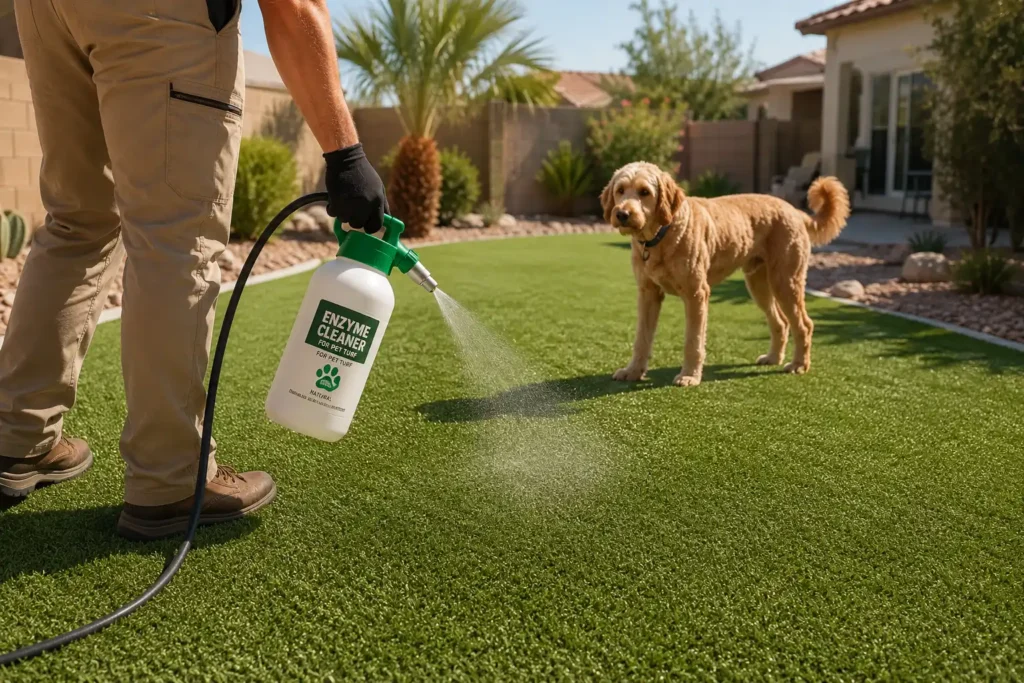
Step 3 — Apply enzyme deodorizer generously
Dilute per product instructions and apply across the full surface, not just the spots that smell. Urine spreads further than the visible wet area, and treating only the obvious spots leaves untreated areas that will continue to smell.
Step 4 — Let it sit for 10 to 15 minutes
This is the step most people skip. Enzyme cleaners need contact time to work. In Arizona heat, the surface dries fast, so applying in the early morning or evening gives the product more time to penetrate before evaporation.
Step 5 — Rinse thoroughly
After the dwell time, rinse the entire treated area thoroughly. This flushes the broken-down compounds and the enzyme product through the drainage system and out of the infill layer.
Step 6 — Repeat weekly during summer
Dog turf deodorizer Arizona applications need to be on a consistent schedule, not a reactive one. Weekly treatment during Chandler and Phoenix summers is realistic for a yard with one to two dogs. Multiple dogs or a small concentrated area may need treatment two to three times per week.
When Deodorizer Is Not Enough
There are situations where no amount of surface deodorizer will solve the problem, because the issue is structural rather than surface-level.
Signs the problem goes deeper than a spray can fix:
- The smell comes back within 24 hours of treatment every single time
- Standing water or slow drainage visible after rinsing
- Dark discoloration in specific areas that does not lift with cleaning
- Smell is strongest immediately after rain or irrigation
- The turf is more than eight to ten years old with original standard infill
In these cases, the urine has either saturated the base layer below the drainage system or the infill has broken down to the point where it can no longer be effectively treated. Professional deep cleaning can address moderate cases. Severe cases may require infill replacement or, in the worst situations, a full reinstall.
For a detailed breakdown of when professional cleaning is the right call versus a full replacement, our guide on artificial turf cleaning in Chandler covers the full decision process.
Professional Dog Turf Deodorizer Treatment in Arizona
DIY enzyme treatment handles routine odor maintenance well. Professional treatment goes further by using commercial-grade enzyme concentrations and pressure application that penetrates the infill layer more effectively than a garden hose application.
Here is when professional treatment makes sense over DIY:
- The turf has not been professionally treated in over 12 months
- You have two or more large dogs using the yard daily
- The smell persists despite consistent DIY enzyme treatment
- You are preparing the yard for an event or selling the property
Professional dog turf deodorizer Arizona treatment costs typically range from $80 to $280 for a standard residential yard in the Chandler and Phoenix area, depending on yard size and the severity of odor buildup.
For ongoing odor control and turf maintenance across the East Valley, visit our turf maintenance service page to see what professional treatment includes.
Preventing Odor Before It Starts
The most effective dog turf deodorizer Arizona approach is prevention. A few habits make a significant difference in how often you need to treat:
- Remove solid waste immediately after your dog goes, every time
- Hose rinse the high-use areas of the turf daily during summer, not weekly
- Apply enzyme treatment proactively on a schedule, not reactively when the smell is already bad
- Consider antimicrobial infill if your turf is due for an infill refresh, it reduces bacterial activity significantly compared to standard sand
For more on removing dog urine odor specifically, including step-by-step guidance on what works in Arizona conditions, our full guide on how to remove dog urine smell from artificial turf covers the process in detail.
Ready to Get the Smell Gone for Good?
If your turf has a persistent odor problem that DIY treatment has not solved, we can help assess whether professional treatment or an infill upgrade is the right next step for your yard.
Call us at (928) 427-2477 or contact Pet Turf Haven here for a free assessment.
You can also check our areas we serve across Chandler, Tempe, Phoenix, and the East Valley to confirm we cover your neighborhood.
Pet Turf Haven, serving Chandler, Tempe, Scottsdale, Queen Creek, Phoenix, and the East Valley.
Leave a Reply